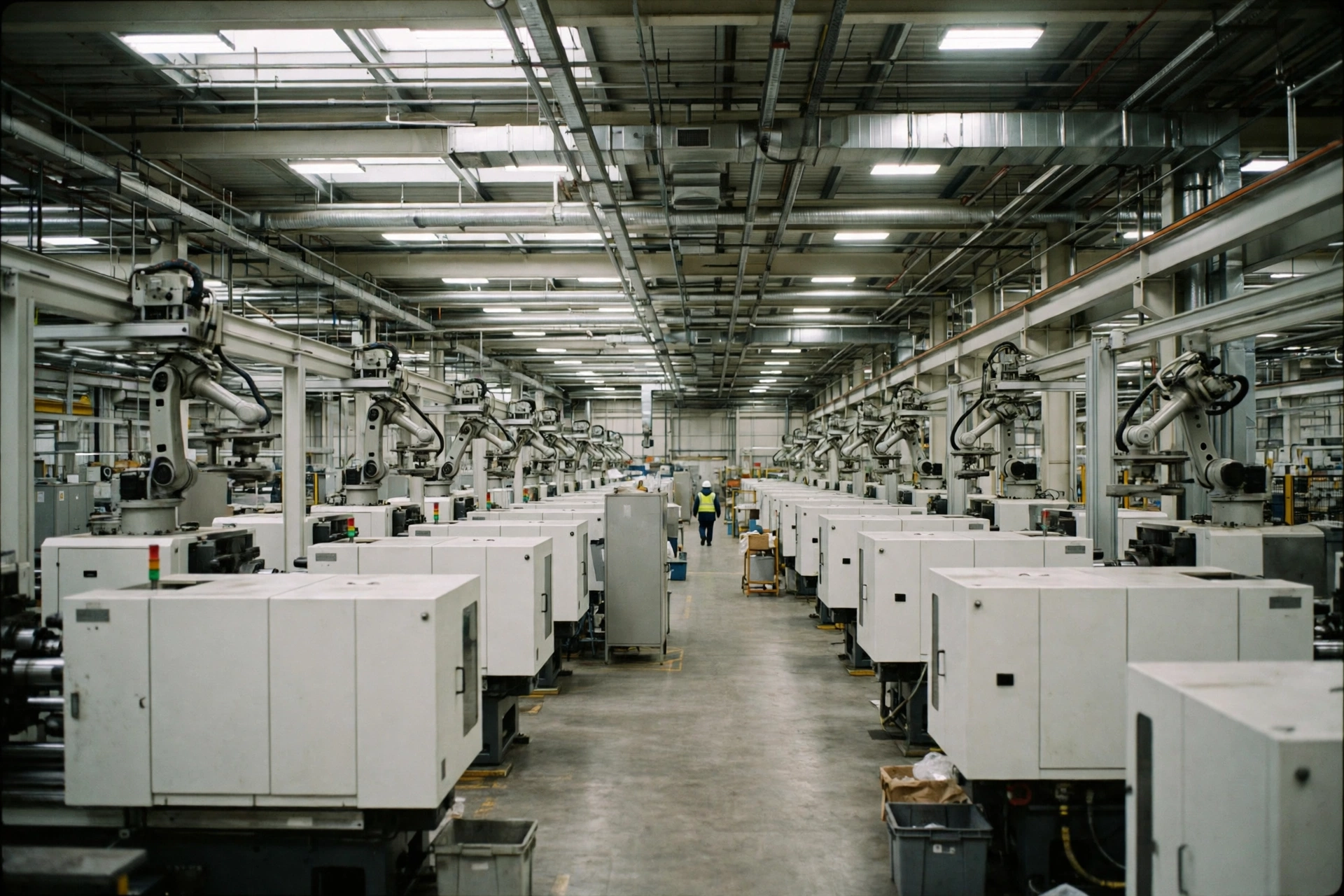
The International Federation of Robotics released its World Robotics 2026 report on September 24, 2026, and the headline figure is hard to ignore. Factories worldwide installed 603,307 industrial robots in 2025, an 11 percent increase that beat the previous record of 552,946 set in 2022 by 9 percent. The global operational stock climbed 9 percent to a record 5 million units. For a plant manager running injection molding presses, the interesting question is not the total. It is which parts of that surge are relevant to a molding floor.
The numbers in one place
| Market | 2025 installations | Change |
|---|---|---|
| World | 603,307 | +11% |
| China | 354,000 (59% of global total) | +20% |
| United States | almost 38,500 | +12% |
| Japan | 36,219 | -19% |
| Republic of Korea | about 30,000 | -1% |
| India | almost 10,500 | +15% |
| Germany | fewer than 25,000 | -8% |
| Mexico | fewer than 5,200 | -7% |
Source: IFR press release and executive summary, September 2026. Two details stand out. The United States overtook Japan to become the second largest market, and India has grown installations by 27 percent a year on average between 2020 and 2025, though from a much smaller base. IFR forecasts 655,000 installations in 2026 and 806,000 by 2029.
Electronics leads, and plastics follows the same logic
By customer industry, the electrical and electronics sector installed 142,235 units in 2025, up 10 percent, keeping the lead it regained in 2024. The automotive industry came second, only about 3,800 units behind. In China alone, electronics installed 96,400 robots, up 16 percent, a 27 percent share of that market. Plastics and chemicals is a smaller customer group. In the 2025 report covering 2024 data, IFR put it at 5 percent of global installations. In Germany, the 2026 report records 2,989 units in plastics and chemical products, a 12 percent share but down 5 percent. Trade coverage of the new report notes that IFR saw robot demand in metal and machinery, plastics and chemicals, and food grow roughly fivefold between 2015 and 2025. So the molding sector is not leading the boom, but it is not standing still either. The link between electronics and molding is practical. Housings, connectors and small structural parts for electronic devices are commonly molded plastic, and each one has to leave the mold and reach a tray or conveyor without a mark. A servo-driven manipulator arm of the SF series type, for instance, is described by its manufacturer as suited to handling smartphone shells, display screens and small printed circuit boards in electronics assembly lines, as well as household items, handles and medical products.
Why demand keeps rising
IFR gives its own reasons in the outlook section. More resilient supply chains and recent trade and industrial policy developments are encouraging manufacturers to relocate or expand capacity. Building capacity in high-wage economies, and in countries facing labor shortages, drives automation. Structural factors such as demographic change support demand, and progress in machine vision, sensing and easier programming is lowering the cost of deployment and widening the range of tasks that make economic sense. That last point matters for molders more than the headline numbers. Ease of programming is visible in product specifications too. The SF series, for example, pairs a 7-inch touch screen handheld controller with 100 mold memories and 18 groups of standard programs, so recalling a stored job takes the place of reprogramming a changeover from scratch.
What an injection molder should take from this
The supply side is crowded and competitive. IFR reports that Chinese manufacturers now hold 55 percent of their home market, with installations up 15 percent to 195,000 units. Buyers have more choice than a decade ago, so specification discipline matters more than brand familiarity.
Safety rules have moved. ISO 10218-1 and ISO 10218-2 were revised in 2025, the first major update since 2011. Anyone commissioning a new cell should check that the integration follows the current text.
Standards remain the safest route to compatibility. On the machine side, the Euromap 67 interface defines how a press and a robot exchange signals such as mold open, and an older Euromap 12 interface survives on many existing presses.
Cycle time still decides robot class. A robot rated for cycles above six seconds, which is how the SF series is specified, is the wrong tool for a three-second thin-wall packaging line, however good the market numbers look.
Frequently asked questions
Is the robot boom mostly an automotive story? Not anymore. In 2025, electronics was the largest customer industry worldwide, with automotive just behind.
Are installations growing everywhere? No. Japan fell 19 percent, Germany fell 8 percent and Mexico fell 7 percent in 2025, while China, the United States and India grew.
Where can I read the original data? The IFR publishes the press releases and executive summaries on its website, and the full World Robotics 2026 report is available from the federation.