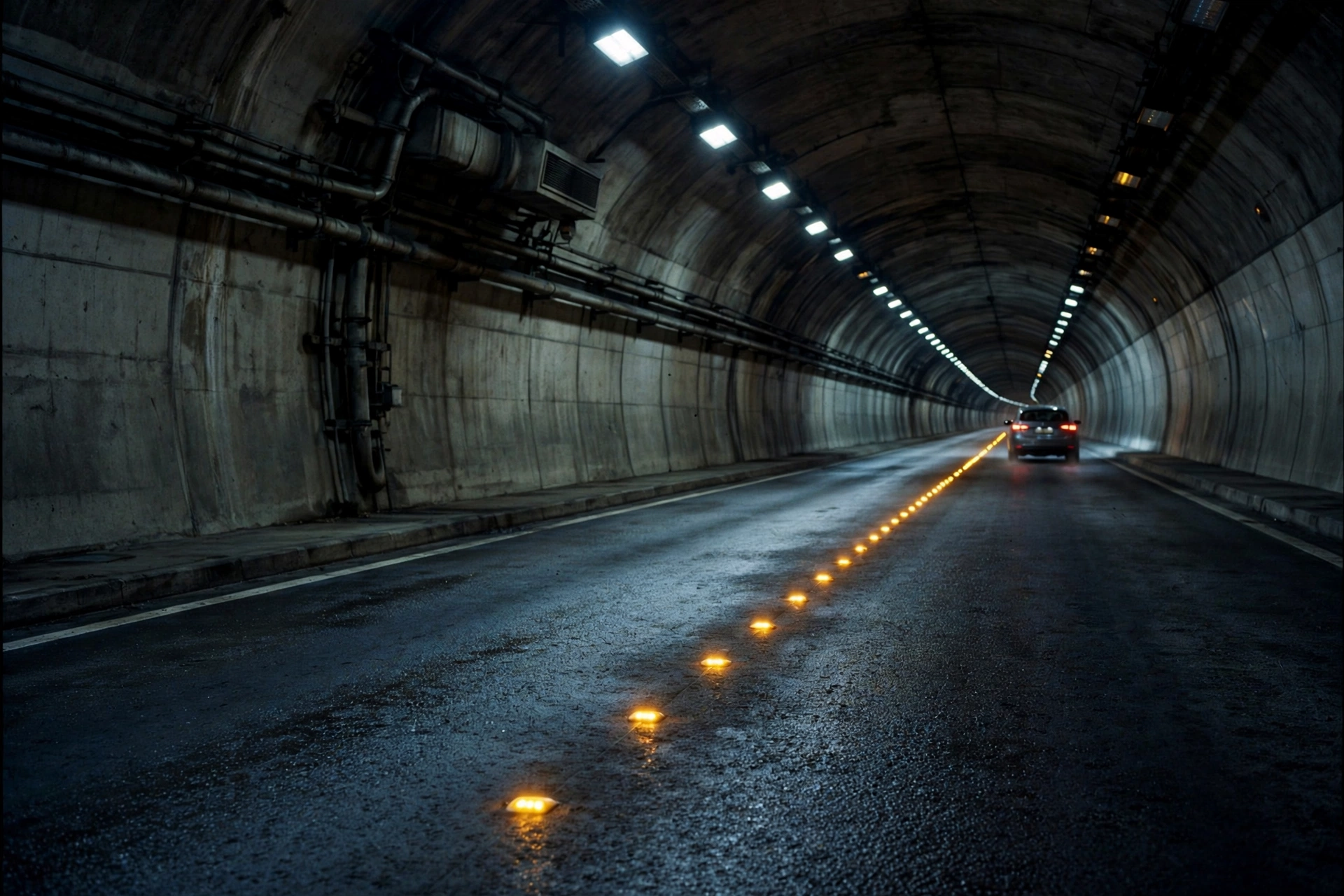
Drive into a long tunnel on a bright afternoon and your eyes lose a fight they cannot win. Outside, light levels run to tens of thousands of lux. Inside, the figure drops to hundreds. Researchers call the resulting struggle to see the "black hole effect," and a paper on tunnel lighting identifies it, along with dark adaptation, as a main cause of accidents near the entrance, the most crash prone part of a tunnel. The international lighting commission's CIE 88 guidance addresses this with graded luminance at the threshold zone. Lighting levels fix the transition. They do not tell a driver where the lane edge is when the road bends inside a mountain, or where the emergency lane starts. That is a guidance problem, and active studs were made for it.
Guidance versus illumination
An active stud is a small powered LED unit set along the road edge or wall. A 2023 driver behavior study reports that active LEDs can improve forward visibility by up to 800 meters over passive reflectors and stay visible where headlights never point, such as around a curve. A separate field study of rural roads where more than 4,200 studs were installed found improved self reported driver confidence. Neither result is a crash reduction figure, and it would be wrong to present them as one. They do show why road authorities keep trialing the technology.
A look at one cast aluminum design
The Cast Aluminum Active Road Stud page describes a die cast housing meant to withstand tire loads and gravel strikes, which is why designers consider metal bodies for roadside maintenance lanes. Listed specifications include a 110 by 100 by 20 millimeter body, 12 LEDs, 0.5 watts per unit, 24 volt DC supply and a temperature range of minus 40 to plus 65 degrees Celsius, with a stated visibility of 500 meters. Colors offered are red, yellow, green, blue and white. The system design is the more interesting part. Control circuits for all studs sit in one central control box, and a single control system is described as managing a run of up to 500 meters. That is a very different maintenance model from placing a driver board inside every stud. As a hypothetical, if one side of a 500 meter run carried a stud every 10 meters, there would be 50 units drawing about 25 watts in total. The load is trivial. The engineering effort goes into cable routing and power distribution.
Modes and what they say to a driver
| Mode | What it does | Where it helps |
|---|---|---|
| Steady on | Constant marker of the road contour | Normal daily operation |
| Synchronized flashing | Every stud on the line flashes together | Entrances, exits, curves, lane changes |
| Flowing sequence | Light travels along the direction of traffic | Long tunnels, to keep drivers oriented |
| One touch switching | Changes mode across the whole system | Fire response, traffic control |
The page also notes that yellow and white are typically used for lane indication, while red and green can mark emergency, escape and fire access lanes. Treat that as a design suggestion, not a rule. The 2023 study found that international regulations do not give consistent prescriptions for LED stud color, so tunnel authorities have to define their own scheme. The same study found that curves marked with white LED studs were perceived as less risky than unlit or red lit curves.
Questions worth asking a supplier
- What is the tested ingress protection rating, and can you supply the certificate? Under IEC 60529, IP65 covers water jets, IP67 temporary immersion and IP68 continuous immersion. Tunnel washing makes this more than a formality.
- Does the controller report faults per stud or only per circuit?
- What is the maximum cable length before voltage drop becomes a problem at 24 volts?
- How is the stud fixed? The maker's installation notes call for adhesive mixed at a 1 to 1 ratio, about 40 to 50 grams per stud, with installation avoided where surfaces are wet or oily.
- What is the recommended curing time before opening the lane?
Quick answers
Are metal studs always better than plastic? No. Metal bodies tolerate vehicle contact better, so they suit road surfaces. Plastic is lighter and works well on walls and barriers.
Can drivers misread colored studs? Yes, if the scheme is inconsistent. This is the reason to document color meaning at the tunnel level.
Does the stud replace tunnel lighting? No. It supports lighting by marking lane and wall contours.